
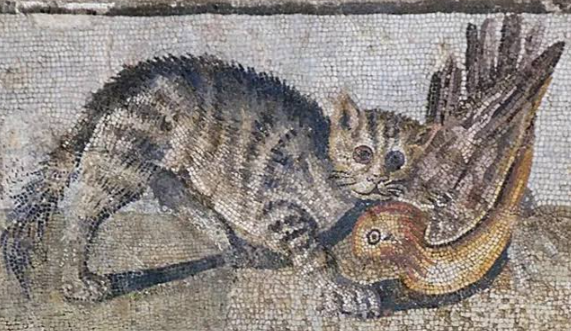
Cats have lived beside humans for thousands of years, yet their domestication did not happen at one clear moment. Unlike livestock that people deliberately captured, bred, and managed, cats appear to have entered human settlements gradually and developed a close relationship with people over a long period.
So, When Were Cats First Domesticated? Most archaeological and genetic evidence suggests that the process began in the Near East roughly 10,000 years ago as agriculture developed. One of the clearest early signs of a close human-cat relationship comes from Cyprus, where a cat was buried near a human about 9,500 years ago. Genetic research also supports the Near East as the main cradle of domestic cat origins.
Cat Domestication Began With Early Agriculture
The earliest stages of cat domestication were closely connected with the rise of farming.
As people in the Fertile Crescent began settling permanently and storing grain, their villages created ideal environments for mice. Rodents were attracted to grain stores, food waste, and buildings where they could find shelter.
Wildcats soon followed.
The ancestors of domestic cats were primarily Near Eastern and North African wildcats, commonly classified as Felis silvestris lybica. These small predators were naturally skilled at hunting rodents.
Humans benefited from having cats around because they reduced pests, while cats gained access to a concentrated food supply.
Genetic research suggests that this relationship may have started developing around 10,000 to 12,000 years ago as agricultural societies expanded across the Fertile Crescent and Levant.
The 9,500-Year-Old Cat Burial in Cyprus
One of the most important discoveries in the history of cat domestication comes from Cyprus.
At the Neolithic site of Shillourokambos, archaeologists found a cat buried in association with a human. The remains date to roughly 9,500 years ago.
This discovery is particularly significant because wildcats were not naturally native to Cyprus. Humans must therefore have transported cats to the island by boat.
That suggests that people already considered these animals useful or socially important enough to take with them when establishing new settlements.
The burial does not prove that cats were fully domesticated in the modern sense, but it strongly indicates that the domestication process was already underway.
Were Cats Domesticated or Simply Tamed?
It is important to distinguish between taming and domestication.
A wild animal can be tamed during its lifetime without its species becoming domesticated. Domestication involves changes occurring across generations as animals adapt to living alongside humans.
Early Neolithic cats may therefore have occupied a position somewhere between wild and fully domestic.
They were probably tolerated around settlements because they hunted rodents. Some may have become familiar with humans and allowed closer contact, while still retaining much of their natural independence.
Over generations, cats that were less fearful of people would have been better able to take advantage of human settlements.
This gradual process is one reason researchers often describe cat domestication as very different from that of dogs or livestock.
Did Cats Domesticate Themselves?
The idea that cats “domesticated themselves” is a simplified but useful way of describing their early relationship with humans.
People probably did not originally bring wildcats into settlements with the intention of creating a new domestic species.
Instead, wildcats were attracted by rodents.
Individuals that tolerated human activity could hunt close to grain stores and buildings, giving them access to reliable prey. Humans had little reason to remove useful rodent hunters.
This created a form of natural selection around human settlements. Cats that were more comfortable living near people had an advantage in that environment.
Over many generations, this relationship helped produce cats increasingly adapted to human communities.
What Role Did Ancient Egypt Play?
Ancient Egypt is often described as the birthplace of domestic cats, but current evidence suggests that domestication had begun thousands of years earlier in the Near East.
Egypt nevertheless played an extremely important role in the later history of cats.
Archaeological evidence indicates that tamed cats were present in Egypt by the fourth millennium BC. Cats later became increasingly visible in Egyptian art, religion, and everyday life.
They were useful around agricultural settlements because they controlled mice and other pests, but they also developed strong symbolic significance.
Feline representations appear in Egyptian art from the late fourth millennium BC onward, and cats later became closely associated with religious traditions and deities such as Bastet.
Egypt therefore represents an important later stage in the transformation of cats from useful pest controllers into culturally significant domestic animals.
How Ancient DNA Changed the Story
Modern genetic research has helped scientists reconstruct the movement of cats across the ancient world.
A major ancient-DNA study examined more than 200 cat remains from archaeological sites across Europe, Africa, and Southwest Asia.
The results showed that Near Eastern and Egyptian populations of Felis silvestris lybica both contributed to the domestic cat population at different times.
The first major expansion occurred during the Neolithic period as early farmers moved through the Near East and into new regions. A later wave associated with Egyptian cats spread much more widely during the Classical period.
This shows that cat domestication was not a single event in one location. It was a long process involving several populations and thousands of years of movement.
Cats Spread With Farmers, Traders, and Sailors
Once cats became associated with human settlements, they began traveling wherever people went.
Early farming communities likely transported cats as they established settlements in new areas.
Later, merchants and sailors recognized another advantage of cats: they could control rodents aboard ships.
Ships carrying grain and other food provided perfect environments for mice and rats. Cats offered an efficient solution without requiring much human management.
Ancient DNA evidence indicates that the spread of cats followed both terrestrial and maritime trade routes. Their distribution accelerated during the Classical period as trade connected Egypt, the Mediterranean, Europe, and other regions.
Why Did Cats Change So Little?
Domestic cats remain surprisingly similar to their wild ancestors.
This is partly because humans did not need to change them very much.
Wildcats were already excellent rodent hunters. Their small size, agility, sharp senses, and independent hunting behavior made them useful around farms, granaries, and ships.
Humans therefore selected less strongly for specialized physical characteristics than they did with dogs, cattle, or horses.
Ancient DNA research also suggests that strong selection for certain coat patterns occurred relatively late. One tabby-pattern variant became common only after the Middle Ages, indicating that systematic selection for appearance intensified long after cats had begun living alongside people.
When Did Cats Become Household Pets?
The transition from working animal to household companion also happened gradually.
For much of history, cats were valued primarily because they controlled rodents. Their role in homes, farms, warehouses, monasteries, and ships often remained practical.
Over time, however, emotional relationships between humans and cats became increasingly important.
By the nineteenth century, organized cat breeding and cat shows helped establish many recognizable breeds and encouraged people to select cats more actively for appearance and temperament.
This period represents a much later stage of domestication than the early agricultural relationship that began thousands of years earlier.
So, When Were Cats First Domesticated?
The best answer to When Were Cats First Domesticated? is that the process probably began around 10,000 years ago in the Near East, alongside the growth of agriculture.
The approximately 9,500-year-old cat burial in Cyprus provides some of the strongest archaeological evidence that humans and cats had already formed a close relationship during the Neolithic period.
Ancient Egypt later became another important center of cat-human interaction, and Egyptian-associated cats spread widely through trade routes across the ancient world.
Cat domestication was therefore not a single event with an exact date. It was a gradual process that began when wildcats followed rodents into early farming settlements and eventually evolved into one of the most enduring relationships between humans and animals.