
下面是一篇约 900 词的英文文章,围绕 “How Wildcats Became House Cats” 展开,并自然融入一次 cat statue。内容也结合了较新的古 DNA 研究,避免把“家猫起源于新月沃地”写成已经完全确定的结论。
How Wildcats Became House Cats
Cats are now among the most familiar animals in human homes, yet their ancestors were independent hunters that had little reason to seek human companionship. Unlike dogs, which were gradually selected for many specialized tasks, cats appear to have followed a different path into domestic life. They were attracted first by the opportunities created around human settlements, and close relationships with people developed gradually.
The story of how wildcats became house cats is therefore less about humans deliberately capturing and breeding wild animals and more about two species discovering that living near each other could be useful. Modern genetic research identifies the African wildcat, Felis lybica lybica, as the principal wild ancestor of today’s domestic cat.
The African Wildcat Ancestor
Modern domestic cats belong to the species Felis catus, but genetically they remain closely connected to African wildcats.
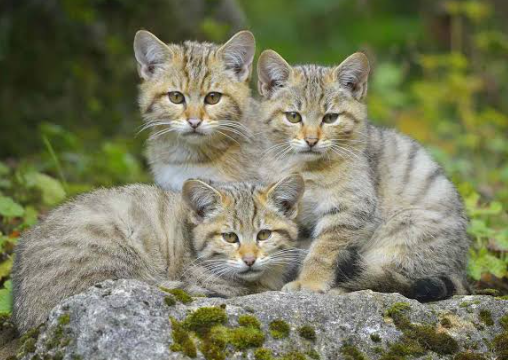
The ancestral population occurred across North Africa and parts of the Near East. These wildcats were small, agile predators with sandy or gray-brown coats, subtle stripes, long legs, and bodies that look remarkably similar to those of many modern tabby cats.
Genetic studies comparing domestic cats with wildcat populations have consistently linked house cats most closely with the lybica lineage rather than European or Central Asian wildcats.
Their natural hunting abilities would eventually become particularly valuable around human settlements.
Farming Changed the Relationship
The development of agriculture created an entirely new environment for small predators.
As people began living in permanent settlements and storing grain, these food supplies attracted mice and other rodents. Rodents, in turn, attracted wildcats.
Instead of being deliberately brought into villages at first, some wildcats probably approached human communities because they offered unusually concentrated sources of prey.
People also had a reason to tolerate them. Wildcats hunting around grain stores could reduce the number of rodents competing for food or damaging stored crops.
This arrangement is often described as a commensal pathway to domestication. Wildcats benefited from living near humans, while humans benefited from their presence, without initially needing to control or breed them intensively.
Not every wildcat would have been comfortable near people.
Animals that were extremely fearful or aggressive were more likely to avoid settlements. Wildcats that tolerated human activity could remain close to villages, where prey was abundant.
Over many generations, this created a form of natural selection.
Cats better suited to human environments had more opportunities to survive and reproduce near settlements. Gradually, populations living around people became behaviorally different from completely wild populations.
Humans may later have reinforced this process by feeding, transporting, protecting, or favoring particular cats.
The result was not an immediate transformation from wildcat to pet. Domestication was a long process involving increasingly close contact between cats and people.
Early Cats and Human Settlements
Archaeological evidence shows that humans and cats were interacting thousands of years ago.
One of the most famous discoveries comes from Cyprus, where a cat was buried near a human around 7,500 BCE. Because wildcats were not native to the island, humans must have transported cats there, demonstrating an unusually close relationship at a very early date.
For many years, evidence like this supported the theory that cat domestication began among early agricultural communities in the Near East.
That theory remains influential, but new genetic evidence has made the story more complicated.
Did House Cats Really Begin in the Near East?
A landmark genetic study published in 2007 proposed that domestic cats originated in the Near East alongside early agricultural societies in the Fertile Crescent.
More recent ancient-DNA research, however, suggests that the exact location and timing of domestication are still uncertain.
A 2025 study analyzing ancient and modern cat genomes found that cats carrying the ancestry characteristic of modern domestic cats apparently did not spread into Europe with early Neolithic farmers. Instead, domestic cats seem to have entered Europe mainly around 2,000 years ago, probably from North Africa.
This means early humans may have formed close relationships with wildcats long before the particular domestic lineage that produced today’s house cats spread widely.
Researchers therefore continue to investigate whether domestication occurred primarily in the Levant, Egypt, elsewhere in North Africa, or through interactions across several regions within the African wildcat’s natural range.
Ancient Egypt and the Growing Human-Cat Bond
Ancient Egypt represents an important stage in the relationship between humans and cats.
Cats appeared frequently in Egyptian visual culture and became associated with domestic life as well as religious traditions. Their ability to hunt rodents made them useful around agricultural communities, while their behavior and appearance also gave them cultural significance.
Over time, humans represented cats in paintings, carvings, amulets, and sculptural forms. Much as a modern cat statue can symbolize affection for the animal today, ancient representations reveal how cats had moved beyond being tolerated hunters and had become meaningful figures within human society.
North Africa may also have played a larger role in the spread of the domestic cat than researchers previously realized. The 2025 genomic study suggests that the population that expanded into Europe roughly two millennia ago probably originated there.
Once cats became useful and accepted around human communities, they began traveling with people.
Ships carrying food supplies had the same rodent problems as settlements on land. Cats therefore had an obvious practical role aboard vessels and around ports.
Trade networks helped cats move between regions of the Mediterranean and eventually much farther across Europe and Asia.
Their expansion was gradual rather than simultaneous.
For example, ancient-DNA research indicates that true domestic cats arrived in China only around 1,400 years ago, probably through Silk Road connections. Before their arrival, local leopard cats had maintained their own long commensal relationship with farming communities, but they did not become the ancestors of modern house cats.
Why House Cats Still Look Wild
Domestic cats changed relatively little physically compared with many other domesticated animals.
Early humans did not need to create a completely different kind of cat. Wildcats already possessed the qualities that made them useful: excellent hearing, rapid reflexes, sharp claws, strong hunting instincts, and the ability to catch small prey.
Modern cats still display many of these ancestral behaviors.
They stalk moving objects, pounce on toys, defend territories, scratch surfaces, hide before attacking, and become highly alert to small sounds.
Even cats that have never hunted for food can perform remarkably complete hunting sequences.
This strong connection to their wild ancestors reflects the unusual way cats entered domestic life.
From Wild Hunter to Household Companion
The transformation of wildcats into house cats was probably not a single event. It was a gradual relationship that developed as wildcats took advantage of rodents around human settlements and people increasingly tolerated their presence.
Genetics shows that today’s domestic cats descend primarily from the African wildcat, Felis lybica lybica. What remains less certain is precisely where and when this relationship crossed the line into full domestication. Recent ancient-DNA evidence suggests North Africa played an especially important role in the later expansion of domestic cats into Europe.
Thousands of years later, the result of that long process can still be seen in every house cat that quietly watches a bird, stalks a toy, or suddenly pounces across the floor. The domestic cat lives comfortably alongside humans, but much of the wild hunter remains just beneath the surface.