
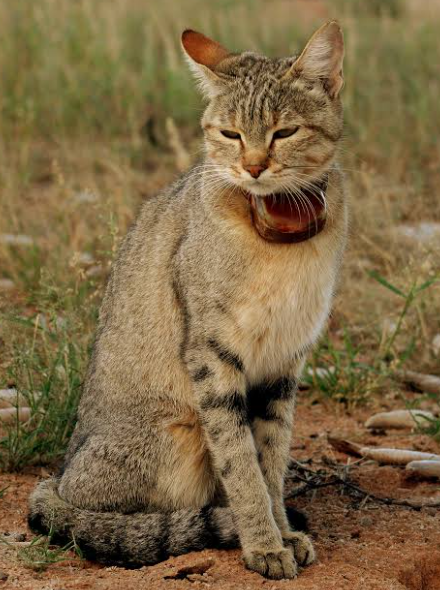
Modern house cats may spend their days sleeping on sofas, watching birds through windows, or waiting beside food bowls, but their bodies and behavior still reveal a remarkably wild heritage. Their stalking movements, territorial instincts, sharp hearing, retractable claws, and preference for hunting alone all connect them to small wildcats that lived across Africa and western Asia.
Understanding The Wild Ancestors of Domestic Cats requires looking primarily at the African wildcat, Felis lybica. Genetic research identifies the North African and Near Eastern form, Felis lybica lybica, as the ancestral population from which modern domestic cats ultimately descended. Recent ancient-DNA research has also shown that the exact place and date of domestication remain more complicated than once believed.
The African Wildcat Is the Main Ancestor of Domestic Cats
The closest wild ancestor of today’s domestic cat is the African wildcat, particularly Felis lybica lybica.
Its natural range includes parts of North Africa and the Near East. These wildcats are relatively small and can look surprisingly similar to ordinary short-haired domestic cats.
Their coats are generally sandy, grayish, or light brown, often with subtle stripes on the legs, body, and tail. Their coloring provides camouflage in dry grasslands, scrub, and semi-desert environments.
Modern genomic evidence strongly supports the conclusion that all living domestic cats ultimately trace their primary ancestry to this wildcat population.
This close relationship explains why distinguishing a wild African wildcat from a feral domestic cat based only on appearance can sometimes be difficult.
Why Older Sources Call It the Near Eastern Wildcat
Readers may encounter several different scientific names when researching cat ancestry.
Older research frequently described the domestic cat’s ancestor as the Near Eastern wildcat, Felis silvestris lybica.
More recent taxonomic treatments often recognize the African wildcat separately as Felis lybica, with Felis lybica lybica referring to the lineage most closely connected with domestic cats.
The terminology has changed, but the underlying conclusion remains similar: modern house cats arose from wildcat populations native to North Africa and the Near East.
A landmark 2007 genetic study compared domestic cats with several wildcat populations and identified the lybica lineage as the source of domestic cats.
Wildcats Were Already Excellent Hunters
Humans did not need to transform early wildcats into effective working animals.
They were already highly specialized predators.
Small rodents, birds, reptiles, and other small animals formed much of their natural prey. Their bodies were equipped for stalking and sudden attacks: flexible spines, strong hind legs, sensitive whiskers, excellent hearing, and sharp retractable claws.
These abilities became particularly valuable when humans began storing food.
Once agricultural settlements appeared, grain stores attracted mice and other rodents. Wildcats following these prey animals encountered a new ecological opportunity around human communities.
This probably formed one of the foundations of the human-cat relationship.
Agriculture Brought Wildcats and Humans Together
For many years, the leading domestication model proposed that wildcats began living around early farming settlements in the Fertile Crescent.
Grain supported growing rodent populations.
Rodents attracted wildcats.
Humans benefited because cats reduced pests, while cats benefited from a reliable concentration of prey.
Unlike livestock, early cats may not initially have been captured and deliberately bred. Instead, individuals that tolerated human activity could remain near villages and continue hunting.
Over generations, cats that were less fearful of people would have been better suited to this new environment.
This is known as a commensal pathway of domestication—an animal gradually benefiting from living near humans before intensive human control develops.
Did Domestic Cats Really Originate in the Fertile Crescent?
This question has become more complicated.
Earlier genetic studies strongly supported a Near Eastern origin linked with the development of agriculture.
However, a major ancient-genome study published in Science in 2025 found that domestic-cat ancestry did not spread into Europe with the earliest Neolithic farmers as previously proposed.
Instead, cats genetically close to modern domestic cats appear to have reached Europe mainly around 2,000 years ago, probably from North Africa. The researchers concluded that the precise location of cat domestication—whether the Levant, Egypt, elsewhere in North Africa, or a combination of regions—remains uncertain.
Therefore, it is now safer to say that the ancestral population lived across North Africa and the Near East, rather than identifying one exact modern country as the proven birthplace of the domestic cat.
What Does the Ancient Cyprus Cat Tell Us?
An important piece of archaeological evidence comes from Cyprus.
At the Neolithic site of Shillourokambos, archaeologists discovered a cat buried in association with a human around 7,500 BCE.
Cats were not naturally native to Cyprus, so people must have transported the animal to the island.
This demonstrates that humans had formed a significant relationship with wildcats or early commensal cats thousands of years ago.
However, newer genetic research introduces an important distinction: an ancient cat living alongside humans was not necessarily a direct ancestor of modern domestic cats.
The Cyprus evidence proves an early human-cat relationship, but it does not by itself establish exactly where the modern domestic lineage was fully domesticated.
Ancient Egypt Played an Important Role
Ancient Egypt remains central to the story of cat domestication.
Cats became highly visible in Egyptian society and were represented in paintings, sculpture, religious imagery, and mummified remains.
Their practical ability to control rodents would have been valuable in agricultural communities dependent on grain storage.
Over time, cats also acquired cultural and religious significance.
Recent genetic evidence suggesting a strong North African contribution to modern domestic cats has renewed interest in Egypt and surrounding regions as possible important centers of domestication or early population expansion.
Cats associated with North Africa later spread through Mediterranean trade networks and into Europe.
European Wildcats Are Not the Main Ancestors
The European wildcat, Felis silvestris, looks similar to a large striped domestic cat, but it is not considered the main ancestor of today’s house cats.
European wildcats represent a separate lineage.
Domestic cats introduced into Europe later encountered local wildcats and sometimes interbred with them. This hybridization continues in some regions and has become a conservation concern because domestic-cat genes can enter endangered wildcat populations.
So although European wildcats and domestic cats are close relatives and can hybridize, the domestic lineage did not principally originate from European wildcats.
Asiatic Wildcats Were Close Relatives, Not the Primary Source
Central Asian or Asiatic wildcats are another closely related population.
They have historically been classified within the broader wildcat complex and share many physical characteristics with both African wildcats and domestic cats.
However, genomic evidence places modern domestic cats primarily with the African wildcat lineage rather than identifying Asiatic wildcats as the original domestic population.
Hybridization among closely related wildcat populations can complicate genetic studies, which is one reason researchers increasingly rely on nuclear genomes rather than appearance or mitochondrial DNA alone.
Leopard Cats Followed a Different Path in China
Ancient China provides an especially interesting comparison.
Archaeological evidence shows that leopard cats, Prionailurus bengalensis, lived around agricultural communities in China thousands of years ago.
For a long period, these small wild cats apparently benefited from living near humans in a relationship similar to the early commensal model proposed for African wildcats.
However, leopard cats did not become the ancestors of modern Chinese house cats.
A 2025 genomic study found evidence for around 3,500 years of human-leopard cat commensalism before that relationship disappeared. True domestic cats arrived in China much later, probably through Silk Road trade around 1,400 years ago.
This demonstrates that living near humans does not automatically result in full domestication.
Why Domestic Cats Still Look So Wild
The transformation from wildcat to house cat required relatively little change in body shape.
Humans needed early cats primarily for something they were already very good at: hunting rodents.
There was little reason to dramatically alter their anatomy.
As a result, modern domestic cats still retain many ancestral characteristics:
- Stalking and pouncing behavior
- Territorial scent marking
- Solitary hunting
- Strong night and low-light vision
- Sensitive hearing
- Retractable claws
- Short bursts of speed
- Grooming behavior
Even a well-fed indoor cat may crouch, stalk a toy, and leap onto it using almost the same sequence of movements as a wildcat hunting prey.
Modern Cat Breeds Came Much Later
Persians, Siamese, Maine Coons, British Shorthairs, and other recognizable breeds belong to a very recent chapter in cat evolution.
For most of the domestic cat’s history, humans did not selectively breed cats into dramatically different forms.
Modern breed development expanded primarily during the last few centuries.
That is why differences among cat breeds are generally much smaller than differences among dog breeds.
Underneath variations in coat length, color, body shape, and size, domestic cats remain remarkably close to their wild ancestors.
A Wildcat Heritage That Remains Visible Today
The story of The Wild Ancestors of Domestic Cats begins primarily with Felis lybica lybica, the African wildcat population native to North Africa and the Near East. Genetic evidence clearly identifies this lineage as the principal ancestor of modern domestic cats.
What remains uncertain is exactly where and when the transition to full domestication occurred. Earlier research emphasized Neolithic farming communities in the Fertile Crescent, while new ancient-DNA evidence gives North Africa a much greater role and shows that modern domestic-cat ancestry reached Europe only about 2,000 years ago.
Despite thousands of years alongside humans, the domestic cat has retained much of its ancestral design. Every time a house cat silently stalks a moving object, marks its territory, or suddenly pounces, it displays behaviors inherited from the small wild hunters that once lived independently across the dry landscapes of Africa and the Near East.