
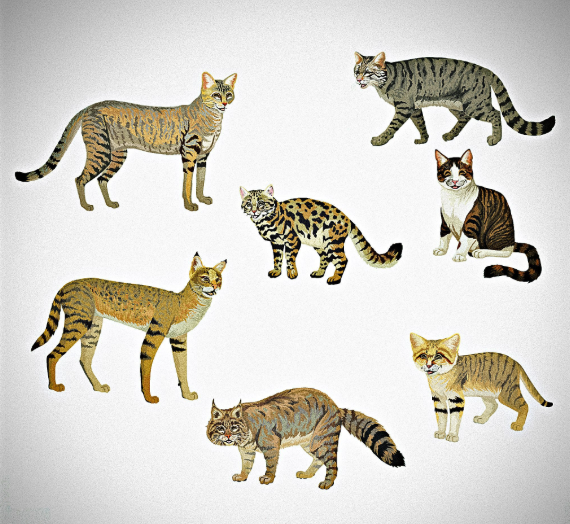
Domestic cats live in homes, farms, cities, and villages around the world, yet they still retain many characteristics of their wild ancestors. Their sharp hunting instincts, territorial behavior, flexible bodies, sensitive hearing, and independent nature reveal a domestication history very different from that of dogs or livestock.
Understanding The Evolution of Domestic Cats means looking at both biological ancestry and the changing relationship between cats and humans. Modern genetic research confirms that domestic cats descend primarily from the African wildcat, Felis lybica lybica. However, new ancient-DNA evidence shows that the exact location and timing of domestication are more complicated than scientists once believed.
The Wild Ancestor of the Domestic Cat
The modern house cat, Felis catus, is closely related to the African wildcat.
African wildcats still live across parts of North Africa and the Middle East. They are small, agile predators with relatively long legs, striped coats, pointed ears, and strong hunting instincts.
In appearance, they can look surprisingly similar to ordinary tabby house cats.
Genetic studies have established Felis lybica lybica as the principal ancestral population of modern domestic cats. This helps explain why house cats still retain so many wild behaviors.
Unlike animals that humans dramatically reshaped through selective breeding for work, transportation, or food production, early cats were already well suited to the role humans found useful: hunting rodents.
Agriculture Created a New Environment for Cats
For many years, the leading explanation for cat domestication focused on the rise of agriculture in the Fertile Crescent.
As humans established permanent farming settlements thousands of years ago, they began storing grain. Grain stores attracted mice and other rodents, which in turn attracted wildcats.
Humans benefited from the presence of efficient rodent hunters, while cats gained access to concentrated prey around settlements.
A 2022 genetic study of more than 1,000 randomly bred cats supported an eastern Mediterranean and Near Eastern center for early cat-human relationships and described a likely commensal pathway in which wildcats gradually became associated with farming communities.
This model remains important, but newer ancient-genome evidence has made the overall story less certain.
New DNA Evidence Changed the Traditional Story
A major study published in Science in November 2025 analyzed ancient and modern cat genomes and challenged the idea that the ancestors of today’s domestic cats spread into Europe with Neolithic farmers.
Researchers examined material from 225 ancient cat specimens across 97 archaeological sites and generated dozens of ancient genomes spanning thousands of years.
Their findings suggest that cats genetically similar to modern domestic cats reached Europe only about 2,000 years ago, during the Roman period, and probably came from North Africa.
The earliest European specimen in the study carrying ancestry characteristic of present-day domestic cats came from Austria and dated to approximately 50 BCE–80 CE.
This means some much older European cat remains previously interpreted as evidence of domestic-cat expansion may actually have belonged to wildcats.
Was North Africa the Center of Domestication?
The 2025 research places much greater emphasis on North Africa.
It suggests that the population contributing most directly to the modern worldwide domestic cat gene pool probably originated somewhere in North Africa rather than spreading into Europe directly from early farming communities in the Levant.
However, scientists still cannot point to one exact place and say with certainty that this is where the first domestic cat appeared.
The researchers themselves note that uncertainty remains over whether domestication occurred in Egypt, elsewhere in North Africa, the Levant, or through interactions involving several regions.
The safest conclusion is therefore that domestic-cat evolution involved Felis lybica populations from North Africa and the Near East, with the precise domestication pathway still being refined by new genetic evidence.
What Does the Ancient Cyprus Cat Tell Us?
One famous piece of evidence comes from Cyprus.
Archaeologists discovered a cat buried near a human at the Neolithic site of Shillourokambos, dating to roughly 7,500 BCE.
Because cats were not native to Cyprus, humans must have transported the animal to the island.
For years, this discovery was treated as strong evidence that cats had already entered an early stage of domestication in the Near East.
It still demonstrates an unusually close human-cat relationship thousands of years before the Roman era.
However, the Cyprus cat does not by itself prove that it belonged to the direct ancestral population of today’s domestic cats. The 2025 genomic research highlights why archaeological association and genetic ancestry need to be considered separately.
Ancient Egypt Remains Extremely Important
Even with the changing genetic picture, ancient Egypt remains central to the history of domestic cats.
Cats became important in Egyptian agriculture, households, religious practices, and visual culture.
Their ability to hunt rodents would have been particularly valuable in a society dependent on stored grain.
Cats also became associated with religious traditions and were represented in paintings, sculptures, and mummified remains.
Earlier genetic studies found that Egyptian-associated cat populations spread widely through the ancient world, particularly during the Classical period.
The newer evidence strengthens the broader importance of North Africa and suggests that populations connected with this region played an even larger role in the ancestry of today’s cats than previously understood.
Cats Spread Along Human Trade Routes
Once cats became useful around settlements, ships, warehouses, and ports, human trade networks gave them an opportunity to spread.
Rodents were a major problem aboard ships carrying grain and other food products. Cats provided an efficient form of pest control.
The 2025 genomic study found domestic-cat ancestry at Roman military and settlement sites across Europe, suggesting that trade, transport, and the expansion of the Roman world helped accelerate their distribution.
Later, cats continued traveling with merchants, sailors, settlers, and other human populations.
This partnership eventually allowed them to colonize environments far beyond the natural range of their wild ancestors.
Domestic Cats Changed Less Than Many Other Animals
One of the most interesting aspects of The Evolution of Domestic Cats is how physically similar domestic cats remain to wildcats.
Humans had relatively little reason to redesign the basic feline body.
Cats were already highly effective hunters. Their excellent night vision, sensitive hearing, retractable claws, fast reflexes, and ability to stalk small prey were useful traits around human settlements.
As a result, artificial selection was weaker than it was for animals such as dogs, cattle, horses, or sheep.
Earlier ancient-DNA research found that strong selection for certain coat-pattern variants appeared relatively late, with one common blotched-tabby variant becoming frequent only after the Middle Ages.
For most of their history with humans, cats were therefore selected more for usefulness and tolerance of people than for dramatic differences in appearance.
Modern Cat Breeds Are Very Recent
The huge variety of recognized cat breeds can make domestic cats seem highly modified, but organized breed development is a very recent stage in their history.
Modern selective breeding became much more important during the nineteenth century, when organized cat shows and breed standards began encouraging people to select cats for coat type, color, body shape, and other aesthetic characteristics.
A 2022 genetics study notes that most specialized cat breeds have developed only during roughly the last two centuries.
Persians, Siamese, Maine Coons, British Shorthairs, and many other recognizable breeds therefore represent only the newest part of a much longer human-cat relationship.
Most cats worldwide are still random-bred rather than members of formal breeds.
Why House Cats Still Behave Like Hunters
Domestic cats continue to display behaviors inherited from their wild ancestry.
They stalk moving objects, hide before pouncing, scratch surfaces, mark territory, groom extensively, and often prefer short periods of social interaction rather than constant group activity.
Even well-fed household cats may chase insects, birds, or small mammals.
These behaviors are not unusual remnants that domestication failed to eliminate. They reflect the fact that cats spent much of their history alongside humans while remaining capable independent hunters.
Their evolutionary success depended partly on retaining these abilities.
The Evolution of Cats Is Still Being Rewritten
The history of the domestic cat is a good example of how scientific explanations change when better evidence becomes available.
Older models emphasized Near Eastern farmers and proposed that domestic cats spread into Europe during the Neolithic. Genetic studies supported strong connections with Felis lybica populations around the eastern Mediterranean.
The 2025 ancient-genome study now indicates that the ancestors most closely related to modern domestic cats arrived in Europe much later—about 2,000 years ago—and probably came from North Africa. It also concludes that the precise place and date of domestication remain unresolved.
What remains clear is that The Evolution of Domestic Cats was not a single event. It was a long interaction between wildcats and human societies involving hunting, agriculture, trade, cultural significance, migration, and eventually selective breeding.
From African wildcats living near human settlements to modern pets sleeping on sofas, cats have changed—but far less than their extraordinary global success might suggest.