
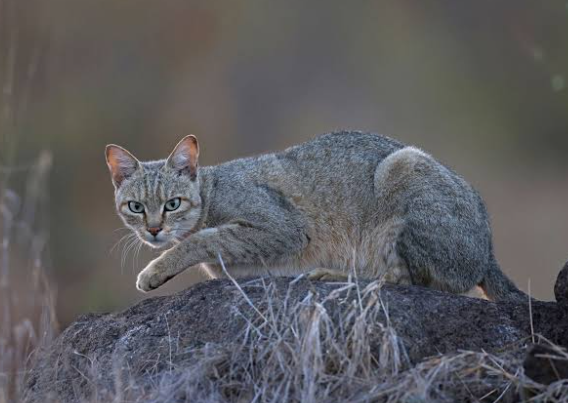
Domestic cats now live almost everywhere humans do, but their relationship with people began thousands of years before modern cat breeds appeared. For a long time, ancient Egypt was commonly regarded as the birthplace of the domestic cat because cats appear frequently in Egyptian art, religion, and archaeological remains.
Modern genetic and archaeological research has changed that picture. So, Where Were Cats First Domesticated? The strongest evidence points to the Near East, particularly the Fertile Crescent and eastern Mediterranean region, where early farming communities began interacting with wildcats thousands of years ago. Egypt later became another major center in the history and worldwide spread of domestic cats.
The Near East Was the Cradle of Cat Domestication
Genetic evidence strongly supports the Near East as the main geographical origin of domestic cats.
A 2022 study examining more than 1,000 randomly bred cats concluded that domestic cat origins were concentrated around the eastern Mediterranean Basin, including areas associated with the Fertile Crescent and Levant.
This region includes parts of what are now countries such as Turkey, Syria, Lebanon, Israel, Jordan, and Iraq.
The important factor was not a particular modern country but a major change in human society: agriculture.
Around 10,000 to 12,000 years ago, people in the Fertile Crescent began establishing permanent farming communities. This created exactly the kind of environment that could bring humans and wildcats together.
Farming Changed the Relationship Between Cats and Humans
Agriculture produced large supplies of stored grain.
Unfortunately for early farmers, grain stores also attracted rodents.
Mice found food and shelter around villages, granaries, and agricultural settlements. Wildcats then followed the rodents.
The principal ancestor of the domestic cat was the Near Eastern and North African wildcat, Felis silvestris lybica. These cats were already efficient hunters of small rodents.
Wildcats that were willing to approach human settlements gained access to concentrated populations of prey. Humans also benefited because the cats helped control animals that could damage valuable food supplies.
This created a mutually beneficial relationship.
Rather than deliberately capturing and breeding wildcats immediately, early farmers probably tolerated useful cats around their settlements. Over generations, animals that were less afraid of humans would have been particularly successful in these environments.
Cyprus Provides Crucial Archaeological Evidence
One of the most important clues to early cat domestication comes not from mainland Asia or Egypt, but from Cyprus.
Archaeologists discovered a cat buried close to a human at the Neolithic site of Shillourokambos. The burial dates to approximately 9,500 years ago.
This discovery is especially significant because wildcats were not native to Cyprus.
The presence of a cat on the island therefore indicates that humans must have transported it across the Mediterranean by boat.
People would probably not have gone to this effort unless cats had already become useful or socially important.
The burial does not necessarily prove that the animal was fully domesticated in exactly the same sense as a modern pet cat. However, it demonstrates that a close human-cat relationship had developed very early in the Neolithic period.
Were Cats Really Domesticated in the Fertile Crescent?
The word “domesticated” can make the process sound more deliberate than it probably was.
Cats were very different from livestock such as cattle, sheep, and goats.
Humans intentionally controlled the breeding, feeding, and movement of many livestock species. Early cats probably required much less management.
Wildcats could hunt for themselves and were naturally attracted to human settlements because rodents were abundant there.
For this reason, researchers often describe cat domestication as a commensal pathway.
Cats initially moved into human environments largely on their own. Humans tolerated and eventually encouraged their presence.
This is why people sometimes say that cats “domesticated themselves.” That phrase is an oversimplification, but it reflects the unusually gradual nature of the process.
What Role Did Ancient Egypt Play?
Ancient Egypt was extremely important in cat history, but it was probably not where the entire domestication process first began.
Evidence suggests that cats had already developed relationships with humans in the Near East thousands of years earlier.
Egypt appears to represent a major later stage.
Archaeological evidence indicates that people in Egypt were keeping or managing cats by the fourth millennium BC. Cat remains found at Hierakonpolis suggest that humans may have been involved in caring for or breeding them earlier than once thought.
Cats later became highly visible in Egyptian society.
They appeared in tomb paintings and sculptures and became associated with religious traditions. Their ability to catch rodents and other small animals also made them practically useful.
Egypt therefore helped transform the cat from a useful animal living near settlements into an increasingly important domestic and cultural companion.
Egyptian Cats Helped Spread Domestic Cats Farther
Ancient DNA research shows that the worldwide expansion of cats occurred in more than one major phase.
One early expansion began with Near Eastern cats during the Neolithic period.
A later population associated with Egypt spread widely during the Classical period. Researchers studying ancient cat DNA found contributions from both Near Eastern and Egyptian populations to the ancestry of domestic cats.
Human trade was an important factor.
Cats were useful on ships because they could hunt rodents that threatened stored food and cargo.
As merchants, sailors, and expanding civilizations moved around the Mediterranean and beyond, cats traveled with them.
Phoenician, Greek, Roman, and other trade networks eventually helped distribute cats across Europe and other regions.
Why Did Cats Spread With Humans?
Cats had several qualities that made them particularly useful traveling companions.
They were relatively small, could reproduce without extensive human management, and were excellent rodent hunters.
Granaries, warehouses, farms, ships, and ports all attracted mice and rats.
Wherever humans transported and stored food, cats could provide valuable pest control.
Their spread therefore followed many of the same routes as agriculture, trade, and expanding settlements.
Ancient DNA research indicates that cat dispersal followed both land and maritime routes, connecting the movement of cats directly with human migration and commerce.
What About Early Cats in China?
Evidence of early relationships between humans and small cats has also been discovered in China.
However, some early Chinese archaeological cats belonged to leopard cats rather than the lineage that produced today’s domestic cat.
This suggests that humans in different regions may independently have developed relationships with local feline species.
The modern domestic cat, however, traces its principal ancestry to Felis silvestris lybica, the wildcat population associated with the Near East and surrounding regions.
This distinction is important when asking Where Were Cats First Domesticated? because not every early human-feline relationship contributed directly to the modern house cat.
Domestic Cats Remained Similar to Wildcats
Another interesting feature of cat domestication is how little their basic body form changed.
Domestic cats still resemble their wild ancestors far more closely than many domesticated dogs resemble wolves.
This reflects the role cats originally played.
Humans needed cats to hunt rodents, and wildcats were already excellent at doing that. There was little reason to radically change their size, anatomy, or hunting behavior.
Ancient DNA studies also suggest that intensive selection for appearance came relatively late. A genetic variant associated with the blotched tabby coat pattern became widespread only after the Middle Ages.
Modern selective breeding is therefore only a very recent chapter in a much longer history.
From Fertile Crescent Wildcats to Household Pets
The answer to Where Were Cats First Domesticated? is therefore more complex than simply naming Egypt.
Current genetic evidence points primarily to the Near East and eastern Mediterranean, especially the Fertile Crescent, where wildcats began living around early agricultural settlements roughly 10,000 years ago or more.
The approximately 9,500-year-old human-cat burial in Cyprus demonstrates that this relationship had already become strong enough for people to transport cats across the sea.
Ancient Egypt later became another crucial center where cats became deeply integrated into human society and from which cat populations spread widely through ancient trade networks.
The domestic cat therefore did not emerge from one deliberate breeding event. Its history began with wildcats, rodents, grain stores, and farming villages—and developed gradually into the close relationship between cats and humans that continues today.