
A domestic cat curled up on a sofa may seem far removed from a wild predator, yet house cats remain remarkably close to their wild ancestors. Their stalking behavior, territorial instincts, sharp hearing, body shape, and ability to hunt small prey all reveal a heritage that began long before cats became household companions.
The relationship between The African Wildcat and Domestic Cats is especially important because modern genetic research identifies the African wildcat, Felis lybica, as the ancestral lineage from which today’s domestic cats developed. More specifically, the North African and Near Eastern form known as Felis lybica lybica is most closely connected with the domestic cat lineage.
What Is the African Wildcat?
The African wildcat is a small wild feline distributed across large parts of Africa and western Asia. Current felid taxonomy recognizes Felis lybica as distinct from the European wildcat, Felis silvestris. The African wildcat group includes populations adapted to environments ranging from dry scrub and semi-desert to grassland and agricultural landscapes.
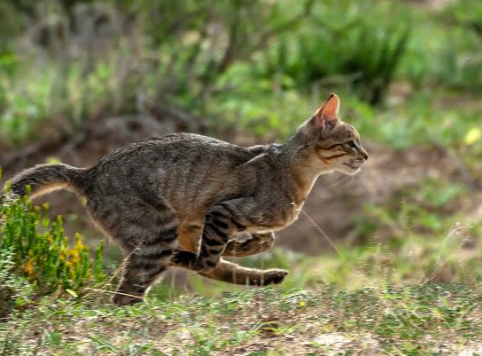
Physically, it can look surprisingly similar to an ordinary domestic tabby.
African wildcats generally have a lean body, relatively long legs, pointed ears, and a narrow tail with dark rings near the end. Their coats range from sandy and tawny brown to gray, usually with faint stripes or spots. Cats living in drier environments tend to have paler coloration, helping them blend into open landscapes.
This similarity is one reason wildcats and feral domestic cats can sometimes be difficult to distinguish by appearance alone.
Are Domestic Cats Descended From African Wildcats?
Genetic evidence strongly supports this connection.
A major genetic study published in 2007 compared nearly 1,000 domestic cats and wildcats from different regions. Domestic cats grouped with the Near Eastern or African wildcat lineage rather than European, Central Asian, or Chinese wildcat populations. This established Felis lybica lybica as the principal ancestral population of modern domestic cats.
More recent genome research has refined that picture.
A 2025 study analyzing ancient and modern cat genomes found that domestic cats form a sister lineage particularly close to African wildcats. The researchers also found stronger genetic affinities between domestic cats and some North African wildcat populations than with modern Levantine populations.
The broad ancestry is therefore clear, even though the precise location and timing of full domestication remain under study.
Why Did Wildcats Approach Human Settlements?
The relationship probably began because agriculture changed the environment.
Once humans established permanent settlements and began storing grain, large concentrations of mice and other rodents appeared around food stores. These rodents attracted small wildcats.
Wildcats that could tolerate living near people gained access to an abundant and relatively predictable source of prey.
Humans benefited as well. Cats helped control rodents that consumed or contaminated stored food.
This relationship is often described as a commensal pathway to domestication. Instead of people deliberately capturing and breeding wildcats from the beginning, some wildcats effectively moved into human-created environments because those environments were useful to them.
Did Cats First Become Domestic in the Near East?
For many years, the dominant explanation placed the beginning of cat domestication in the Fertile Crescent.
The 2007 genetic study argued that domestication probably occurred alongside early agricultural villages in the Near East. This fitted well with the idea that rodents around grain stores brought wildcats and farmers together.
However, newer ancient-DNA evidence has made the story less straightforward.
Research published in Science in 2025 concluded that modern domestic-cat ancestry did not spread into Europe with the earliest Neolithic farmers. Instead, domestic cats appear to have reached Europe mainly around 2,000 years ago, probably from North Africa. The study therefore cautioned that the exact center of domestication—whether the Levant, Egypt, elsewhere in North Africa, or a wider region—remains uncertain.
This means early relationships between humans and wildcats may have developed in more than one place before the domestic lineage familiar today became widespread.
Why Do House Cats Still Look So Wild?
Domestic cats changed relatively little in body shape during domestication.
Humans did not need to transform them into specialized workers because wildcats already possessed the qualities people found useful.
They were efficient rodent hunters with excellent hearing, strong low-light vision, fast reflexes, sharp claws, and the ability to move quietly.
As a result, the basic body plan of the domestic cat remained close to that of the wildcat.
Many common short-haired tabbies still strongly resemble African wildcats, although domestic cats now display a much wider variety of coat colors, patterns, hair lengths, and body types.
Wild Instincts Remain in Domestic Cats
Behavior provides another obvious connection.
A house cat may never need to hunt for food, yet it still performs many of the same actions as a wildcat.
It may crouch low, watch a moving object, move forward silently, pause, and then pounce. Cats also scratch surfaces, mark territory, seek hiding places, react strongly to small sounds, and defend preferred resting areas.
These behaviors reflect an evolutionary history as small solitary predators.
Domestication increased cats’ tolerance of humans and, in many cases, other cats, but it did not erase the hunting instincts that helped their ancestors survive.
From Useful Hunter to Cultural Companion
Over time, cats became much more than animals tolerated around food stores.
Their relationship with humans gradually expanded from practical pest control to companionship and cultural significance. Ancient Egyptian art, for example, shows that cats had become recognizable figures within domestic and religious life.
That cultural role continued to develop over later centuries. Cats appeared in paintings, stories, decorative objects, and sculpture. Today, even something as simple as a cat statue can represent companionship, independence, elegance, or affection for an animal that has shared human environments for thousands of years.
This change from useful hunter to cultural symbol reflects how deeply cats became integrated into human life.
African Wildcats and Domestic Cats Can Still Interbreed
The evolutionary relationship between wild and domestic cats is so close that they can still produce fertile offspring.
This creates an important conservation issue.
When free-ranging domestic or feral cats enter wildcat habitats, they can mate with wild populations and introduce domestic-cat genes. Genetic studies in southern Africa have documented hybridization between African wildcats and domestic cats.
Conservation organizations therefore consider hybridization one of the major threats to maintaining genetically distinct wildcat populations, particularly in areas close to farms, towns, and other human settlements.
African Wildcats Are Not Feral Cats
Although they can look similar, African wildcats and feral domestic cats are not the same thing.
A feral cat is a domestic cat that lives without regular human care. It belongs to the domestic lineage even if it behaves cautiously around people.
An African wildcat belongs to a naturally occurring wild population that evolved independently before domestication.
Because hybridization has occurred in some regions, the distinction can become genetically complicated. Researchers sometimes need DNA rather than appearance alone to determine whether an individual is a wildcat, domestic cat, or hybrid.
A Wild Heritage Inside the House Cat
The connection between The African Wildcat and Domestic Cats explains why modern cats still retain so much of their original appearance and behavior.
Genetic research clearly links house cats with Felis lybica lybica, while newer ancient-DNA evidence suggests that North African populations played an especially important role in the domestic lineage that later spread into Europe.
Domestication changed how cats interact with people more dramatically than it changed their basic anatomy.
That is why a modern house cat can spend the afternoon sleeping comfortably indoors and, moments later, display the movements of a small wild predator when it spots a bird, insect, or moving toy. The environment has changed, but much of the African wildcat remains visible in the domestic cat today.