
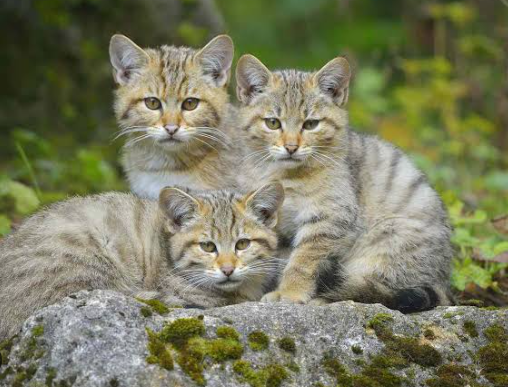
Cats now live alongside people in homes across the world, but their story began thousands of years before the modern house cat appeared. Unlike dogs, cattle, or horses, cats were probably not domesticated through an intensive human breeding program at first. Instead, the relationship between cats and people seems to have developed gradually when wildcats began visiting early farming settlements.
So, Where Do Domestic Cats Come From? Genetic and archaeological evidence points mainly to the Near Eastern and North African wildcat, Felis silvestris lybica. These wildcats began living near agricultural communities in the Near East thousands of years ago, eventually spreading with people across Europe, Africa, Asia, and later much of the rest of the world.
The Wild Ancestor of the Domestic Cat
Modern domestic cats are closely related to the African and Near Eastern wildcat, commonly classified as Felis silvestris lybica.
At first glance, this animal can look surprisingly similar to an ordinary tabby cat. It generally has a slender body, long legs, a sandy or grayish coat, and darker stripes around the legs and tail.
Genetic research has strongly linked domestic cats with this wildcat population. A 2022 genetic study of more than 1,000 randomly bred cats supported an origin centered in the eastern Mediterranean and surrounding Near Eastern regions.
This means that the ancestors of today’s house cats were not originally a separate domesticated species. They were wild predators that gradually adapted to environments created by humans.
Cats and the First Farming Communities
The beginning of cat domestication is closely connected with the development of agriculture.
Roughly 10,000 years ago, people in parts of the Fertile Crescent increasingly settled in permanent communities and stored harvested grain. Large grain stores attracted mice and other rodents.
Rodents, in turn, attracted wildcats.
For wildcats, human settlements offered a reliable supply of prey. For humans, cats provided a useful form of pest control. This created a relationship in which both species benefited.
Cats that were less fearful of humans may have spent more time around settlements, while people were likely more tolerant of animals that reduced rodent populations.
Rather than people deliberately capturing wildcats and immediately turning them into pets, domestication probably developed through this long-term association. Genetic evidence supports the idea that cat domestication began within developing agricultural societies of the Near East.
Evidence From Ancient Cyprus
One of the most important clues in the early history of domestic cats comes from the Mediterranean island of Cyprus.
Archaeological evidence has identified an early association between a human and a cat dating to roughly 9,500 years ago. The significance of the discovery is especially important because wildcats were not naturally native to Cyprus.
People therefore must have transported cats, or their wildcat ancestors, to the island by boat.
The discovery suggests that humans already valued cats enough to move them between locations during the Neolithic period. The 2017 study of ancient cat DNA also identifies this early Near Eastern expansion as part of the first major phase in the worldwide dispersal of cats.
Did Domestic Cats Come From Ancient Egypt?
Ancient Egypt is often described as the birthplace of the domestic cat, but the full story is more complicated.
Current evidence indicates that the earliest stage of cat domestication began farther east in the Near East rather than exclusively in Egypt. However, Egypt became extremely important in the later development and spread of domestic cats.
Ancient DNA research has identified both Near Eastern and Egyptian populations of Felis silvestris lybica as important contributors to domestic cat populations. The first major expansion was associated with early Near Eastern farmers, while cats associated with Egypt spread widely during later periods.
Egypt therefore played a major role in cat history even if domestication did not begin there alone.
Why Were Cats Important in Ancient Egypt?
Cats became especially prominent in ancient Egyptian society.
Their practical usefulness was clear. Cats could hunt mice around food stores and homes, and they could also kill snakes and other small animals.
But their role eventually extended far beyond pest control.
Cats became important in Egyptian religious imagery and symbolism. They were associated with divine figures, including Bastet, and appeared in statues, paintings, amulets, coffins, and other objects.
The Smithsonian notes that cats occupied several roles in Egyptian culture, ranging from household animals used to control mice and snakes to symbolic representations connected with rulers and deities.
Some cats were also mummified and offered in religious contexts. Numerous surviving cat mummies illustrate how closely felines became connected with Egyptian religious life.
How Did Cats Spread Into Europe?
Cats did not remain confined to the Near East and Egypt.
As human trade networks expanded, cats traveled with merchants, farmers, and sailors.
Their rodent-hunting abilities made them particularly valuable aboard ships. Food supplies and cargo could attract mice and rats, so keeping cats aboard vessels had a practical advantage.
Ancient DNA studies indicate that cats spread through terrestrial and maritime trade routes. Egyptian-associated cat populations became especially widespread during the Classical period.
Research on ancient European cats also suggests that domestic cats became much more established in Western and Central Europe during Greek, Phoenician, and particularly Roman expansion.
In this way, human movement helped transform a regional wildcat lineage into an animal found across much of the Old World.
Cats Traveled With Sailors and Traders
Ships became one of the most important ways cats expanded their geographical range.
Rodents were a persistent problem aboard merchant and naval vessels because they consumed food, damaged cargo, and reproduced rapidly.
Cats were natural predators that required little specialized training.
As ships moved between ports, cats could travel from one region to another. Some remained aboard vessels, while others entered port settlements and mixed with existing cat populations.
Over many centuries, maritime trade helped cats spread around the Mediterranean and farther into Europe, Africa, and Asia.
This explains why the history of domestic cats is also closely connected with the history of human transportation and trade.
When Did Modern Cat Breeds Appear?
Although cats have lived with humans for thousands of years, most modern cat breeds are surprisingly recent.
For much of their history, cats were valued primarily for their ability to control rodents. People had less reason to breed them intensively for specific body shapes, coat lengths, or colors.
Ancient DNA research suggests that certain coat pattern variants became common relatively late, with stronger selection for appearance developing long after the earliest stages of domestication.
More organized breeding expanded particularly during the nineteenth and twentieth centuries, when cat shows and breed registries became popular.
This eventually contributed to recognizable breeds such as Persians, British Shorthairs, Siamese cats, and many others.
Why Do Domestic Cats Still Seem So Wild?
Modern cats retain many characteristics of their wild ancestors.
They stalk prey, defend territories, sharpen their claws, respond strongly to movement, and often prefer having control over social interactions.
Their body structure has also changed less dramatically than that of many domesticated animals.
This is partly because early humans did not need to transform cats extensively. Wildcats were already well suited to the job humans valued most: hunting rodents.
As a result, domestication focused more on tolerance of humans than on completely changing feline anatomy or behavior.
Even a cat sleeping comfortably on a sofa still possesses many of the hunting instincts that helped its ancestors thrive around early farming settlements.
From Wildcats to Household Companions
So, Where Do Domestic Cats Come From? The answer begins with wildcats living in the Near East and North Africa.
As farming communities developed, rodents gathered around grain stores, attracting wildcats. A mutually beneficial relationship gradually formed between cats and people. Early cats then traveled with farmers, traders, and sailors, while Egyptian populations later contributed significantly to the expansion of domestic cats across the ancient world.
Over thousands of years, these practical pest controllers became household animals, cultural symbols, selectively bred companions, and eventually familiar pets around the world.
The domestic cat’s history is therefore not simply the story of humans taming a wild animal. It is the story of two species gradually adapting to one another as agriculture, settlements, trade, and civilization expanded.